Reflecting on New Year’s Eve

It is New Year’s Eve as I write this, and that is always a day of reflection whether you want to reflect or not. We’ve now pretty much run out of time to accomplish whatever is incomplete—or not even begun—on our to-do list for 2024.

Birthdays often spark reflection, too, but such reflection is usually limited to the birthday-ee, family, and perhaps a few friends. Our entire society, indeed, the entire world seems to reflexively reflect on New Year’s Eve.

Reflection is not an easy exercise, producing as it usually does, a certain melancholy. When we are younger, we often reflect on the triumphs and tragedies that whizzed along throughout the year; but then, you reach a certain age at which you’re mostly aware of the whizzing. At one time, you couldn’t wait to get to school-age, driving-age, drinking age. . . . Old age. You think you’ll never get to the next fun-filled stage, but it turns out it doesn’t take long to reach that last one—old age. Not as long as you thought it would, anyway. The ellipses i.e. the three dots that appear a couple of sentences back, are a perfect symbol. Old age is really just a hop (.) skip (.) and a jump (.) and there you are. I’m far more bewildered by that hop, skip, and jump than saddened. Being sad about it makes as much sense as being sad that the world spun around once since this time yesterday.

I cannot celebrate New Year’s Eve with the same gusto that I used to, but I can celebrate with all the gusto I’ve got and there’s something very satisfying about that.

This ole Earth is about to begin another trip around the sun. That’s a marvel. That we’re all passengers on the 2025 Excursion is a marvel. Our memory of past trips—good or bad—is a marvel; our anticipation of this new trip is a marvel. Resolve to embrace the marvelous whatever your age and have a happy new year.

Posted in Life is Interesting | Tagged , , | 8 Comments

Ernest Borgnine illustrates a fundamental principle of life

When I was a kid, I had no idea that I was watching Academy Award winners every week on the television. I only knew Ernest Borgnine as Captain Quentin McHale of McHale’s Navy, not as an Oscar winner for Marty. Or that he had a prominent role as a villain in From Here to Eternity. Barbara Stanwyck was Victoria Barkley on The Big Valley. I had no idea that she had been a major film star with two Academy Award nominations, one for 1937’s Stella Dallas and the second for Ball of Fire two years later. I certainly had no idea that she and Steve Douglas, aka Fred MacMurray with his three TV sons, had co-starred in Double Indemnity back in 1944.

I didn’t know that Mrs. Partridge, i.e. Shirley Jones, won an Academy Award for her role in Elmer Gantry and as a prostitute at that! I didn’t know that Donna Reed had ever performed in anything but The Donna Reed Show; or that Raymond Burr and Barbara Hale had successful film careers before Perry Mason.

Later, sometimes years later, I’d be watching TV and suddenly exclaim, Hey! Look who it is!

We come into this world unaware of the past. We begin to know about it maybe around the age of five—which for me was 1962, the year McHale’s Navy debuted—but we’re not really aware of it. In any case, we’re quite certain that whatever happened back then has nothing to do with us. After all, at five years old, I pretty much knew everything I needed to know about navigating the world, which for me basically consisted of my home and family. My world, however, was expanding rapidly even then; I just didn’t know it. When I did realize it, the world seemed to be expanding in only one direction—forward. Into the future.

Eventually, I became aware of what went on before; that Captain McHale had a past. For that matter, so did my parents.

Although it took quite a while, I went on to discover that Time not only moves forward, it also moves backward, and simultaneously at that. Every moment of time is not just connected to the moment that came before and the one that comes after, but to every moment that’s ever been.

It’s like a Parade with no beginning and no end. When enough elephants and marching bands and floats have passed, you realize how many must have come before you arrived at the parade. You become aware of the enormity of it all and that it is both awesome and aw-full. I mean, it’s a joy, but it’s a bit scary at the same time. I became eager to discover where all this started, so I ran back in Time toward the front of the Parade. I ran past 1962 and kept going. I watched Marty and From Here to Eternity and listened to the old music (which is new to me) and I passed my parents and then my grandparents when they were young. That’s about as far as I could go, though.

Sooner or later, the Parade catches up again. In fact, it’s marching along faster now than it used to. But, here I am, this senior citizen five year-old, sitting on the shoulders of my earlier self, getting a good view in both directions. In the distance I can see the Ernest Borgnine float is about to come by once more. It is much larger and grander than it was the first time.

Books make great Christmas gifts!

Remember, dear readers, books are wonderful Christmas gifts. I invite you to visit both the Baseball Books and the Fiction page to pick out a few presents! These two pages contain links to an individual book’s Amazon page. Thank you for your loyal support over the years and Merry Christmas!

If you’re losing your mind over Rob Manfred’s idiotic idea of “The Golden At-Bat,” then I especially recommend this volume.

Posted in Baseball Books, Life is Interesting | Tagged , , , , , , , , , , , , , | Leave a comment

Another Sunday Night

Adam shook his head and huffed a brief laugh as he wheeled the garbage can to the curb.

Another Sunday night, he thought. Wasn’t just yesterday last Sunday?

The robins chit-chatted about some matter or another as the sun set.

The days of the week now passed in a blur, a pleasant blur to be sure: Facetiming with the grandkids, going out to breakfast, cards on Wednesday nights, pickle ball on Friday mornings, grocery shopping, cleaning, doctor appointments . . . but there was always that quiet moment on Sunday nights down at the curb with the robins or rustling leaves or the neighbor and his dog padding along through a skiff of snow. Sunday night at the curb was when time stopped, and when it started up again, it would go faster than it did the week before.

Another Sunday.

Adam ran into the house. “We did it, Dad! We did it!” he shouted, waving his newly acquired Baltimore Oriole World Series pennant. Adam’s parents had taken him to the fourth, and as it turned out, deciding game of the 1966 World Series. Frank Robinson had homered off Don Drysdale for the game’s only run. “We sure did, Adam!” said his father. “Ain’t the beer cold!”

All of Baltimore loved that Sunday evening.

Adam waved to his neighbor across the street. He was just finishing up a Wiffle ball game with his young son.

Returning to the porch, he sat on the swing next to Kate. Her nose and cheeks were a bit red from their weekend at the beach. “Should we tell them?” asked Kate.

“Tonight’s as good a time as any,” he answered. Adam took Kate’s hand and they walked into the house. “Mom, Dad,” he began. “Kate and I are engaged.”

The crickets and tree locusts began to compete with the robins. Someone way down the street was wheeling his garbage cans to the curb, too.

Adam walked back into the house. Kate was just hanging up the phone. “Adam,” she said, working to control her voice. “Your dad just died.”

Adam hung his head. “He had a good life,” he said. Kate swallowed him in her arms and he began to cry softly on her shoulder.

“What’s wrong, Dad?” asked Laura.

“Grandpa died,” answered Kate.

“Oh, I’m sorry, Dad,” said Laura, who began to cry as well.

Huh, thought Adam. All those things happened on a Sunday. Well, maybe they happened. Sometimes, especially on Sunday and most especially at dusk, he wondered if they ever really did happen. Maybe he was just remembering a movie that he saw about the life of a guy named Adam. Maybe he’d always lived here on this street and maybe he had been 67 years old his entire life. He could comprehend being 67, but the idea that his dad had been dead for 20 years—20 years!—that was incomprehensible. Or was it 21? He must have actually attended that World Series game because the pennant still decorated a wall in his basement. Couldn’t have been yesterday, because the pennant read 1966.

Still at the curb, Adam saw a light go on upstairs. That was Kate, already putting on her pajamas. She wasn’t part of a movie. . . . Still. . . .

Adam shook his head and huffed a brief laugh as he headed back to the house.

Another Sunday night, he thought.

Posted in Five Minute Fiction for Free | Tagged , , | Leave a comment

Presenting a new context tool for Major League statistics

Perhaps the most important consideration to come out of the debate regarding the incorporation of Negro League statistics into the major league record book is the need for context. Many have cited the brevity of the Negro Leagues schedules as a prime reason not to include those statistics. In other words, Negro League numbers were not amassed in the same seasonal context as the 154 or 162 game schedules of the major leagues. The context in which any baseball statistic exists has changed and evolved on a number of levels over the years and, therefore, comparing historical eras is just as confounding as comparing the Negro Leagues to the major leagues.

There were myriad changes to the rules and the diamond in the 19th century. John McGraw of the old Baltimore Orioles changed the game with the Baltimore chop and the hit and run. Babe Ruth moved the game from the deadball era to the live-ball era. Consider still further the changes not often considered: Major League Baseball has gone from playing on race-track infields, to dedicated fields, to well-groomed fields, to outdoor carpeting on concrete, to today’s synthetic turf. Lighting and drainage have improved dramatically in that time.

Training, diet, and overall health have also improved tremendously. (To put the exclamation point on that statement, here’s a video of Don Larsen being interviewed in the dugout after his perfect game, smoking a cigarette and drinking a beer!)

 Another totally under-appreciated context is the evolution of the baseball glove. It has gone from little more than padding for the hand to a catching machine.

Context is not limited to grounds or equipment. Think of how the approach to the game has changed and I’m not referring merely to strategy. Obviously, the batter from any era is trying to hit the ball as hard as he can and physics tells us that momentum equals mass times velocity. (p=m x v) In baseball’s beginnings, the emphasis was very much on mass; hence long, heavy bats. Somewhere in baseball’s history—and I’d love to read a study tracing the roots of this change—velocity became the most important part of the equation; hence the emphasis on bat speed. That change has altered the way the game is played and which players are signed. Teams don’t look for big strong guys such as Jimmie Foxx who can wield those old war clubs, but for guys such as Gunnar Henderson who clearly possesses a body full of fast-twitch muscles.

The only way to measure the greatness of any player is not by raw, unfiltered statistics, but to examine how good he was compared to his peers. Yes, there are now statistics based on league averages, but these are neither easily calculated nor easily understood. The concept of peer comparison needs a simple, new metric: the Peer Batting Number (PBN) and the Peer Pitching Number (PPN).

I define the Peer Number for hitters as OPS minus the league average. Simple. And it takes into account ball striking ability, judgment of the strike zone, and power. For example, if the American League average OPS was .732 in 1927, which it was, Babe Ruth’s 1927 OPS of 1.258 would result in a Batting Peer Number (BPN) of .509. The leads his peer and teammate Lou Gehrig by a little and almost everyone else by a lot.

The Pitching Peer Number (PPN) is calculated by applying the same idea to WHIP and ERA, i.e. the pitcher’s seasonal or career total minus the league average in the respective categories, then adding the two results. WHIP, of course, is the most direct, and perhaps accurate measurement of a pitcher’s ability to get outs. While ERA has its flaws, it is still a reasonable measure of runs allowed. The Pitching Peer Number sheds interesting light on two extreme seasons: 1930, known as the greatest offensive season ever and 1968, known as the “Year of the Pitcher.” The PPN suggests that in the context of the respective seasons Lefty Grove in 1930 had a better year than Bob Gibson in 1968. Gibson’s 1.12 ERA plus his 0.853 WHIP results in a PPN of 539. Lefty Grove registered a 2.54 ERA and a 1.144 WHIP, both significantly higher than Gibson’s totals. However, Grove’s PPN is 590. For that matter, the Dodgers’ Dazzy Vance wasn’t far behind Grove with a 583 PPN based on a WHIP identical to Grove’s and an only slightly higher ERA at 2.61. Upon reflection, it should not be surprising that the best pitcher(s) in the greatest offensive season of all-time had a better season relative to his peers than the best pitcher in the Year of the Pitcher. It is also interesting to note that Gibson’s WHIP was not the lowest in the majors that year, a distinction that went to the Orioles’ Dave McNally at .842. That number and McNally’s 1.95 ERA produced a PPN of 452, by the way.

The BPN and the PPN formulas can be easily adjusted by fans more versed in mathematics than I, perhaps with the use of OPS+ and ERA+, which adjusts for the influence of the home ballpark. Perhaps, home run totals or strikeout totals would be desired as part of the formula. It is also important to note that the major league averages for a season or for the length of career can be easily substituted for league averages to judge against the entirety of a player’s peers.

It is impossible to compare Mike Trout to Mickey Mantle to Babe Ruth to Josh Gibson to Ty Cobb based on career totals because of the eras and/or leagues in which they played. We can, however, compare the performances over a season or over a career in the context of that player’s peers’ performances. When and if the Negro League records are completed we will have a much better idea of just how good some of those numbers really are.

Posted in Baseball in General | Tagged , , , , , , , , , , , , , , | 2 Comments

Precious little context for Negro League statistics

It is a shame that the baseball fans who genuinely argue for the inclusion of Negro League statistics as part of the major league record have had their arguments overshadowed by people who are solely interested in creating confrontation. For example, one Facebook commentator posted early-on in the debate that if you can’t accept the Negro League statistics as part of the major league record then, “You are a racist. It is that simple.” It is never that simple, but this debate has often been that ignorant.

The legitimate debate has been interesting and enlightening beginning with the reminder that several different leagues have been deemed “major” and have had their statistics included in the overall totals. In 1968-1969, Major League Baseball reviewed its list of what leagues were “major” in preparation for the publication of The Baseball Encyclopedia, a weighty tome (literally—it weighs 6.5 pounds) listing every major league player and his statistics up to that time. Leagues so designated as major included the American Association (1882-1891), the Union Association (1884), the Players’ League (1890), and the Federal League (1914-1915). I had never given it much thought until now, but why are the Union Association (1884) and the Players’ League—both of which lasted only one full season—considered “major?” Why are either of the other two, for that matter? Six of the twelve Union Association teams for example, never came close to completing their seasons. The National Association, the first professional baseball league (as opposed to the first professional team) was reclassified as a minor league because of the NA’s “erratic schedule and procedures,” according to the Negro Leagues Statistical Review Committee (NLSRC) quoting that 1968-1969 report. This is the committee that just released its own report declaring that Negro League statistics will be part of the Major League record, and it is this report that has stirred all the controversy.

Further in the report the NLSRC writes, “The parity of Negro League play with that of the American and National Leagues is beyond dispute.” Despite the committee’s disclaimer, there is a great deal of “dispute” out there among fans and scholars.

If the Negro Leagues were major and the statistics are to be considered as such, then I need more than a 17-person committee’s say-so. I know all about Josh Gibson and Satchel Paige, et.al, but tell me about the average player; show me the performance of the league as a whole. I haven’t found it so far.

There is no link to any Negro League statistical data base on the MLB website. The Seamheads.com website has been working on Negro League statistics for several years, but there are no Negro League seasonal or career lists that I can find there. Random teams from random years have rosters with accompanying statistics on Seamheads.com, but that’s all I have come across. Baseball Reference.com now includes Negro Leaguers among its leader lists, but I can’t find a compilation of Negro League statistics for any Negro league in any season.

In fact, Tetalo Vargas now resides at the top of the single season batting average list for his .471 average in 1943. Josh Gibson is now listed second behind Vargas with a .466 average, also in 1943, but that in itself raises red flags concerning the quality of the league for at least that year. Not one, but two players hitting above .465 in the same season? Were these two that good or was the league akin to Senior Softball where everyone is expected to hit .400? Put another way, was the average player in the Negro Leagues similar to Mario Mendoza or Juan Soto?

Vargas’ team, the New York Cubans played a 34-game schedule in 1943, and the center fielder amassed 136 plate appearances. I wonder what the results would be if you took the best 34-game stretch of any number of players from Ty Cobb to George Brett to Luis Arráez. Would any of them top .471? If the NLSRC could tell me that no one in the history of the major leagues has ever enjoyed as productive a 34-game stretch, then such context would make Vargas’ accomplishment more meaningful—and more admirable.

Perhaps the most interesting statement in the NLSRC report is the following: “Today the 1920-1948 Negro Leagues records are estimated to be nearly 75% complete.” [Italics added.] Producing even 75% of those records would definitely provide some kind of context as to the validity of the Negro League statistics.

The next installment of this blog will examine the need for contextual consideration across all baseball statistics.

Rickwood Field in Birmingham, AL is the former home of the Birmingham Black Barons and the site of MLB’s Negro League tribute game to be played June 20, 2024
Posted in Baseball in General | Tagged , , , , , , , , , , | 11 Comments

Pitching an idea for wins and losses

Batters don’t get “wins”; should pitchers?

It’s hard to believe that the 2024 major league baseball season is already 25% complete. Of course, it’s hard for me to believe that it’s already Wednesday as I write this, but I digress . . .

It seems that starting pitchers are pitching less than ever and are increasingly removed before completing five innings, which a starter must do in order to qualify for a win. That statistic—“the win,” as well as “the loss”—is no longer valued in this analytical day and age because too many factors may account for a team winning a game on any given day. Two big factors include how well a pitcher’s defense plays and how many runs his teammates score for him. A team could commit three errors that lead to an unearned run while scoring no runs on offense resulting in the pitcher being tagged with a 1-0 loss. Conversely, a starter could surrender nine runs in five innings, but his teammates scored ten in the first four and thus, he is credited with the win.

As it is the rule requiring a starting pitcher to pitch five innings in order to qualify for a win was an arbitrary decision made in 1950. All kinds of rubrics were used before then to assign individual wins, including “injury wins” and “World Series warm up wins.” In baseball’s formative years i.e. the 1860s and 1870s no pitcher was credited with a win because it didn’t make sense to say that one player was more responsible for a win than another, an argument that sounds rather modern. (For a fascinating history of how wins were awarded to individual pitchers see Frank Vaccaro’s article, “The Origin of the Modern Pitching Win.”)

There is a simple solution for the problem of how to assign pitching wins: Every pitcher who pitches in a game that his team wins is credited with a win. We get rid of the “hold” statistic and that meaningless save statistic. The one exception would be that if a pitcher comes into a game and surrenders the lead, even if his team then comes back to win, that pitcher is not credited with a win. He’d get nothing. The guys who pitched before him and after him get a W, but not that guy. Yeah, I can think of all kinds of exceptions, but let’s keep it simple.

As for losses, I wouldn’t bother assigning them at all. They’re just not the same as wins. If you pitched in a winning game and never surrendered the lead, then you contributed to the win. If you pitched in a losing game, you might not have contributed to the loss. For example, say a starting pitcher—we’ll call him Bob—gives up one run in five innings, but his team doesn’t score while he’s in the game. Both teams go on an offensive tear over the last four innings and Bob’s team loses 10-9, but never at any point does it tie the game or take the lead. Under the current rules, Bob would get the loss, but is that one run the one that beat Bob’s team?

Pitchers have all kinds of statistics to measure how effectively they pitched that have nothing to do with whether the game is won or lost. In fact, hitters are judged based on how well they hit the baseball, not whether their hits contributed to a win.

I may be missing something in all this. . . . Actually, I’m pretty sure that I’m missing something, but such a revision in the rules would 1) more closely reflect the current situation and 2) simply make more sense than quantifying the idea that one guy is responsible for his team’s “win.” At the end of the season, the most valuable pitchers would certainly be evident. They’d be the guys who pitched in the most winning games.

Posted in Baseball in General | Tagged , | 8 Comments

Project complete

Project completed!

Yesterday, the Cincinnati Reds became the 1964 World Series Champions. How can that be? Three years ago, on March 21, 2021 I began playing a 90-game 1964 Major League season with my 1964 Strat-O-Matic table-top baseball game. That is to say, the player-cards reflected their statistical performances from 1964. With 10 teams in both the American and National Leagues back then, this represented 900 games. Naturally, I kept a stat sheet on each team and am working on an analysis of how my Strat-O-Matic players and teams compared to the real thing. With the NL analysis complete, I can say that the results were very realistic with just enough differences to add to the fun. Yesterday, the Reds defeated the New York Yankees 5-1 at Yankee Stadium in Game 5 of the World Series (you think I wouldn’t play a World Series?) The Reds took the Series four games to one.

Playing 900 games means that on average, there has been a game from 1964 unfold on my basement folding table on four out of five days over the past three years.

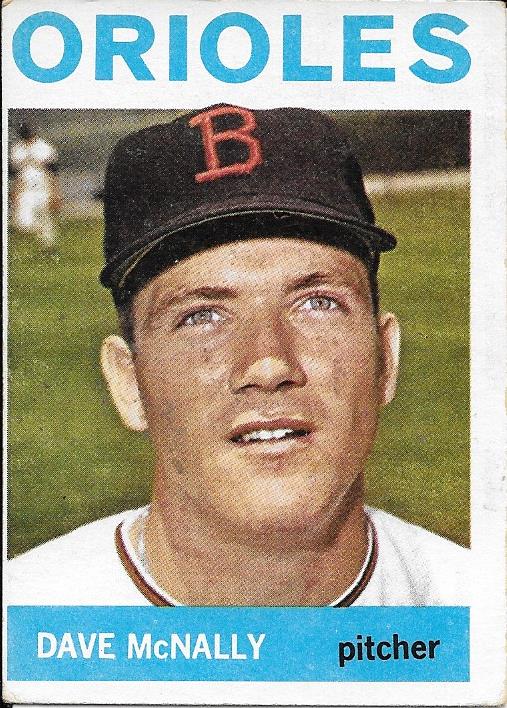
I sent weekly reports to my buddy Al, who followed the pennant races as enthusiastically—if not more so—than he followed the actual pennant races over the past three years. We remembered many names from George Alusik to Pete Ward and Steve Boros to Gerry Zimmerman. Others we didn’t exactly remember, but we remembered what their baseball cards looked like. Here’s Dave McNally’s Topps card from 1964. McNally, one of my favorite players, was such a baby face; young and eager to start a major league career. Just like we were even if we were in elementary school and he was already in the majors.

I cannot say that this was a labor of love—there was no labor involved at all. And while I’ll miss those guys from my childhood—I chose the 1964 set because that was the first year that I began to follow baseball—I already have a 1941 season mapped out. Can’t wait to see if Joe DiMaggio puts together a lengthy hitting streak and if Ted Williams tops the .400 mark. Perhaps, history will repeat itself and I’ll be there for every pitch.

Here’s Ted Williams 1941 Strat-O-Matic card. We’ll see if the Splendid Splinter can bat .400 in my basement
Posted in Baseball in General | Tagged , , , , , , , , | 2 Comments

Diamond in the rain

The Men Who Saved Baseball and other baseball stories debuts one week from today! Remember, if you would live in the greater Winchester area and would like a signed copy, please message me and I will be sure to order a copy for you.

The vignette that follows is not included in The Men Who Saved Baseball for the very good reason that I wrote it after the book was assembled and submitted for publication! So for the moment, think of me as the guy at Costco standing there with some really expensive toothpicked cheese and consider the below a free sample.

***

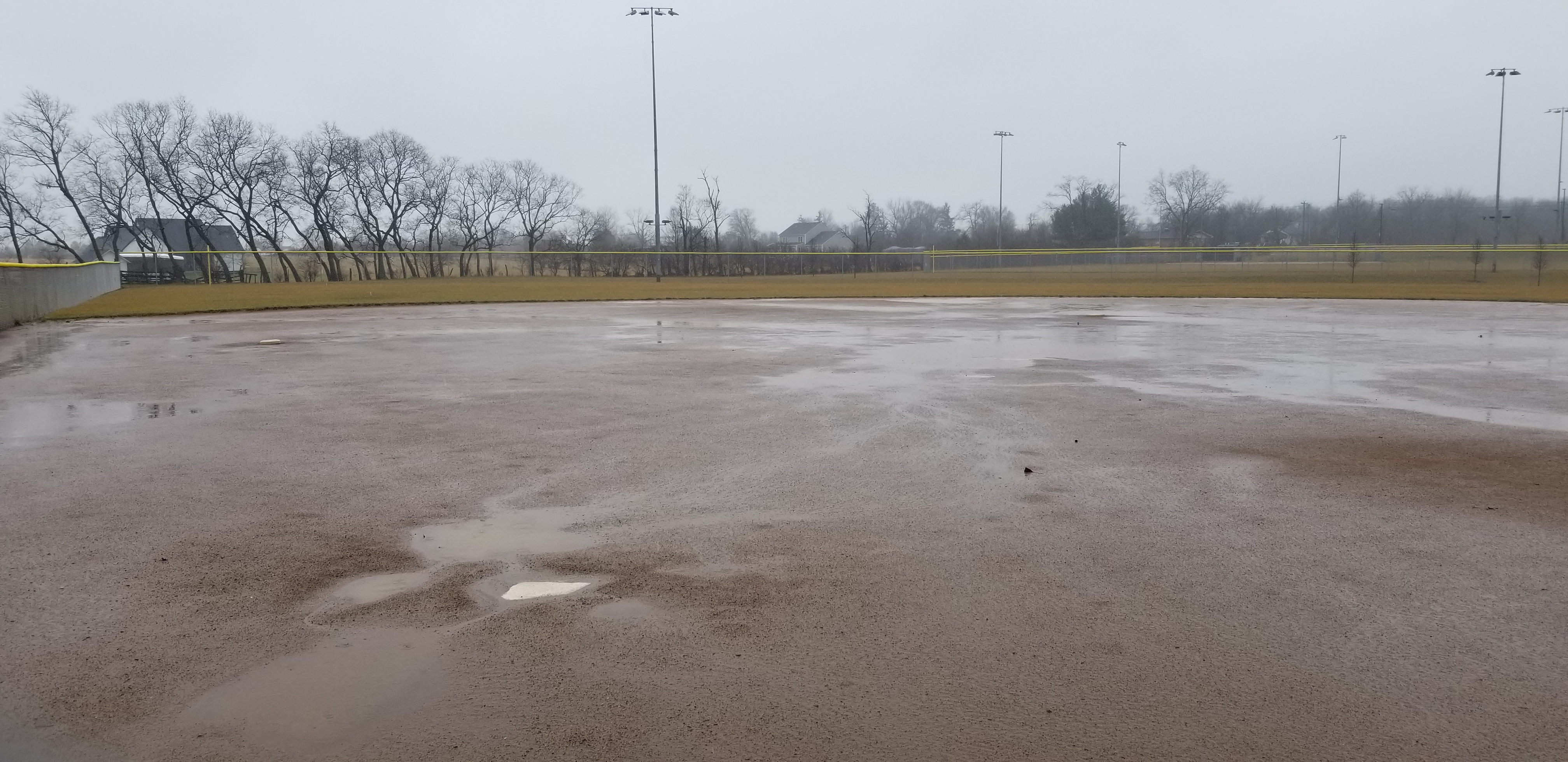
I happened by our local ballpark recently on a gray, damp day that is not unusual for January here in the Mid-Atlantic. Mother Nature could not make up her mind whether to simply hang her clouds low or just go ahead and get foggy. Nor could she make up her mind whether to full-out rain or simply drizzle, and so she vacillated between the two.

Having poured throughout the night, the all-dirt diamond glistened like the actual jewel. It had rained so hard that even the outfield sported puddles to go along with the universal pools around first base, in front of the rubber, and, of course, the right handed batter’s box. Still, I was called to pull over, get out of my car, and contemplate this soggy scene through the backstop fencing. As I peered through the chain link and the rain, I had the sense that this ballfield was quietly waiting.

Hibernating might be a better word than waiting. Having fattened itself on last summer’s joy, it was simply in a hazy slumber knowing it would grow vital again on next summer’s hopes and heroics.

As I gaze, I don’t see any ballplayers out there in the field, only Robert Frost emerging from the wood on a snowy evening to stand nearby and look out over that diamond with me. Frost was a big baseball fan, and a pretty fair ballplayer in his youth. We strike up a wordless conversation, then nod to one another when I head back to my car and he heads off to . . . a horse-drawn sleigh, I suppose.

I turn the windshield wipers up a notch as Mother Nature seems to be leaning more towards rain than drizzle at the moment, but I drive off into a much brighter day.

Posted in Baseball Books, Writing | Tagged , , | 4 Comments

An interview with Mo Weber, an “inspirational character”

I have made many wonderful friends through baseball, and one of my most treasured baseball buddies is Mo Weber, who rounded third for the last time in July of 2019 and headed for Home after 96 years, 64 of which he spent coaching. I knew quite a bit about the game, but my baseball education didn’t really begin until I met Mo, who is the basis for the character Max McGowan in “I love it here in Indiana!” That story appears in The Men Who Saved Baseball and other baseball stories which will be released two weeks from today.

The story revolves around three younger men who must decide the best way to honor Max now that he has died. They vow to spread Max’s ashes on his old ball diamond back in Indiana, but they run into complications. When I outlined the plot to Mo, he said in his usual dry way, “How about you keep me alive in the next story?”

I interviewed him about the coaching he did in the semi-pro leagues in South Dakota in the early 1950s, and that interview appears below. Watch and meet the inspiration for Max McGowan. If you knew Mo, I’m sure this will bring back warm memories.

A NOTE: If you live in the greater Winchester, VA area and would like to order a paperback copy, please let me know and I will include your order with my initial author-copy order. That way, the next time I see you, I can hand you your autographed copy. Thank you, and enjoy the chat with Mo.

Posted in Baseball Books, Writing | Tagged , , , , , , , | 2 Comments

The Men Who Saved Baseball

There are two joys associated with the Christmas season. One is the joy of the season itself with decorating and baking and visiting friends and family. The other is getting back to the regular routine.

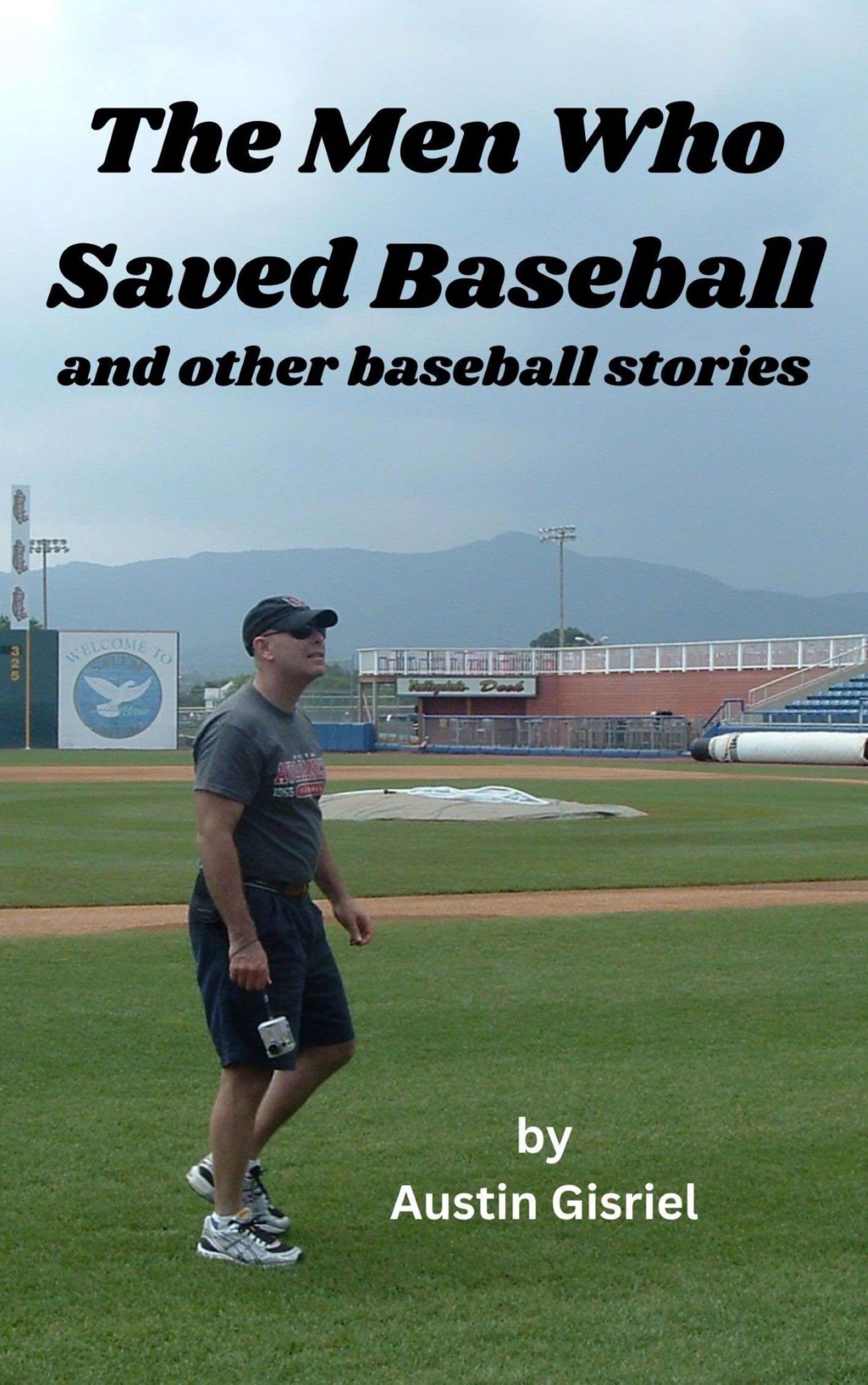
As you all know, part of my regular routine is writing and now that the 2023 Noel is no more I am putting the finishing touches on my latest project, The Men Who Saved Baseball and other baseball stories. This collection of fiction, essay, and memoir also includes “Their Glorious Summer,” the story of the 1981 Valley League championship race. This article has been available as a free download (and continues to be available as such) but is now available in paperback for as part of this collection.

The Men Who Saved Baseball and other baseball stories will be released on February 6th—Babe Ruth’s birthday. After all, with his prodigious home runs and larger-than-life personality, the Babe saved baseball in the wake of the Black Sox scandal. To provide quick perspective, eight White Sox players, including Shoeless Joe Jackson were banned for life from baseball in 1921 for allegedly throwing the 1919 World Series. But the talk of baseball that year was Ruth who Ruth out-homered every other team in the major leagues.

Major League Baseball, in the eyes of many of us, needs to be saved once more only this time from itself. The gimmicks, the over-extended playoffs, and—ironically enough—the emphasis on gambling has detracted from the game. Simply put, the MLB Powers That Be don’t appreciate their own product. I fixed that, at least in my imagination. You see, in the titular story of The Men Who Saved Baseball, a Midwestern soybean researcher, James “Dutch” Sojabonen, develops a gasoline additive that makes him a fortune. An avid baseball fan, he starts his own professional league. The first year of the All-American League is modestly successful, but when Dutch signs “Sweet Daddy” Davidson, he finds the league’s version of Babe Ruth. The entire nation discovers the league and the fact that baseball has never lost its magic.

The Men Who Saved Baseball and other baseball stories will be available in paperback or e-book form on February 6th. Please mark the date and order yourself a copy!

Posted in Baseball Books, Writing | Tagged , , | 2 Comments