Dear MLB: Who Cares?

The collective bargaining agreement that existed between the Major League Baseball Players Association and Major League Baseball expired December 2, 2021. The two parties have been unable to come to any agreement in the 85 days between then and today, although they didn’t start negotiations until the middle of January. In any case, if no agreement is reached by 5:00 p.m. this afternoon, MLB will begin to cancel regular season games, spring training having already been delayed.

Who cares?

Not me, anymore.

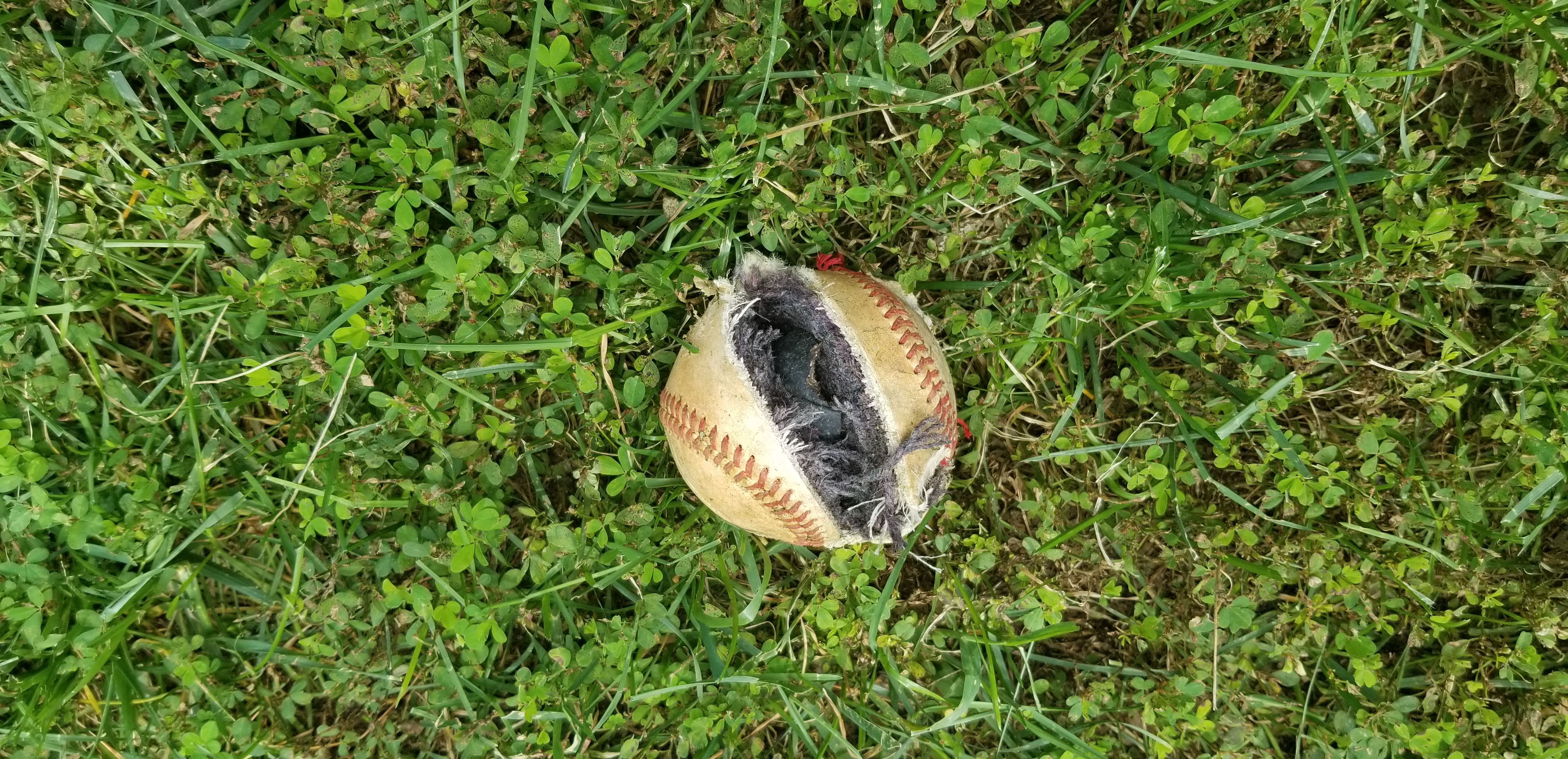
My “fandom” has been well-documented and dates back to 1964 when I was seven, but MLB has trifled with my affections once too often. It thinks it is the game of baseball, but it is not. It is a corporation whose business is baseball, but it is most decidedly not the game. The game may be found in backyards and local diamonds and high school fields and at the nation’s colleges. This last, the college game, is rising in popularity and is doing so for one simple reason—it is entertaining. Meanwhile, professional baseball is becoming much less so. In its quest for perfection by experimenting with electronic strike zones and promoting lengthy replays; in its quest for pitchers who do nothing but strike out batters and batters who do nothing but hit home runs—or strike out—major league baseball has been reduced to a robotic sameness.

Of course, the quality of play in college is not nearly as good as it is even in the low minor leagues, but that contributes to its unpredictability. Consider the series played on Opening Weekend, February 12-14 this year in Austin, Texas between the #1 ranked University of Texas and Rice University. It featured a Texas infielder, Skyler Messinger, swinging at a pitch that hit him in the brim of his helmet. Except for the fact that this was strike three, he walked away none the worse for wear. Such oddball plays happen with much more frequency in college ball.

By no means, however, is college ball some poorly played exhibition. The UT/Rice series also featured two mammoth home runs by Longhorn first baseman, Ivan Melendez. The first was blasted over the batter’s eye in center; the second was launched over the scoreboard in left center. Each one traveled more than 450’. (Highlights of this game may be seen here. Melendez’ first homer comes at about the 5:00 minute mark, while homer #2 occurs at 8:22.) Those homers were baseball at its finest regardless of the level.

Perhaps the most interesting thing about this series against the unranked Rice Owls, is that it drew the largest Opening Weekend crowd in the history of Texas baseball. MLB take note of that. And of this: 2021 National Champion Mississippi State has sold 13,000 season tickets for 2022. (The Bulldogs’ Dudy Noble Field has 15,000 seats.)

If the college game features less skill, it more than compensates by featuring more fun. The fans are more enthusiastic and engage in a variety of celebrations and superstitions. The players are also much more apt to do something such as what you’ll see in this video announcing the new uniforms that Liberty University (just down the road from me in Lynchburg) will be wearing. This video alone should be enough to turn you into a college baseball fan:

I’ll still root for my beloved Orioles, but whether they start the season in April or in May or in 2023, just doesn’t matter anymore. What I can’t wait for is the last weekend in March when LSU visits the University of Florida. That will be fun that I can count on.

Posted in Baseball in General | Tagged , , , , , , | Leave a comment

Those dance masters were a persistent bunch

Yet another mention of the concern over dirty dancing appeared in the January 17, 2022 edition of the Winchester Star‘s “Out of the Past” feature. The following is dated January 12, 1922:

The “jazz” dance is slowly but surely being discarded, according to a statement issued by Fenton Bott, director of dance reform of the American National Association of Masters of Dancing.

The association began two years ago, to work for cleaner dancing. Bott said, “We feel and hope that the crest of the wave of disgusting wriggling “jazz” has been reached, and reports to us from every part of the country show clean dancing crusaders being started everywhere. All exaggerated movements, especially of the upper parts of the body, are in very bad taste in social dancing and are never found with true refinement and culture.”

Of course, we know that the Masters of Dancing failed, and by a wide margin. In fact, that “wave” of “disgusting wriggling ‘jazz,” the crest of which they claim had been reached, was just beginning to swell. At that very moment in history, the Charleston and a dance called “the breakaway” were being fused up in Harlem to become what we now know as the Lindy Hop, so named by Shorty George Snowden in 1929. The video below, from that same year, is the first known recording of the Lindy Hop on film. In fact, the guy in the third couple shown is Shorty George.

According to an article in the September 30, 2012 edition of the Philadelphia Dance History Journal, the National Association of Masters of Dancing was formed in 1883 in Boston. (Of course.) In fact, multiple dance associations were springing up in response to the “sorry state” of American dancing in which less formal steps were crowding out the formal European steps. The two-step, for example, which was overtaking the waltz in popularity was dubbed “the idiot waltz.” In any case, these associations not only appointed themselves as the guardians of morality on the dance floor, they also saw an opportunity to promote their own dances and hence, sell more lessons. Some things in the dance world haven’t changed. If you’re a dancer, you’ll enjoy the article and I encourage you to click on the link and read it.

As it turns out, the American National Association of Masters of Dancing still exists and after having merged with an international association, now simply goes by “Dance Masters of America.” You can visit their website, which provides a brief history of the organization here. The site has a tab for teacher training, competitions, their convention, and others, but I do not see any information on “bad taste in social dancing.” Guess they gave up on that.

Posted in Dance | Tagged , , , , , , , , , | 2 Comments

Does this guy belong in the Hall of Fame, too?

Back in early December, after the voting for baseball’s Hall of Fame was announced, I made the case that Gil Hodges’ election was problematic in that if he could get in, then there are a number of very good players who are every bit Hodges’ equal, and who, therefore, should also be enshrined in Cooperstown. I opined that Hodges was admitted because he played on the fabled Brooklyn Dodgers team of the 1950s, and I compared his lifetime statistics to another, very similar first baseman, Boog Powell. Another comparison has come to mind as well. His accomplishments appear below, after a review of Hodges’:

Hodges played 18 seasons and was an eight-time All-Star. He received MVP votes in nine different seasons with a top finish of 7th. His Career Shares MVP score as calculated by baseball-reference.com is .65, which ranks 402. He made seven post-season appearances and was part of two World Series winners.

He won three Gold Gloves, but never topped his league in any fielding category in any season. Twice he led the league in sacrifice flys, twice in games played, and once in strike outs.

For his career, he hit 370 home runs and tallied 1,274 RBI. His career slash line was .273/.359/.487.

Compare Player also played 18 seasons and was a seven time All-Star. He was an MVP twice and received MVP votes in five other seasons. His Career Shares MVP score as calculated by baseball-reference.com is 2.31, which ranks 77. He made only one post-season appearance.

He won five Gold Gloves and led the league in putouts or assists four times while playing center field. He twice led the league in homers, RBI, and slugging percentage, while leading the league once in runs, walks and OPS.

For his career, he slugged 398 homers and tallied 1,266 RBI. His career slash line was .265/.346/.469.

Our Compare Player’s 8th most similar batter as calculated by baseball-reference.com is Gil Hodges. Interestingly, his 3rd most similar batter is Hodges’ teammate, Hall of Famer, Duke Snider.

Our Compare Player played for a succession of terrible Atlanta Braves teams, about which there will soon be a book written*, but which has not been celebrated in any way shape or form in the way Hodges’ Brooklyn team has been celebrated, even mythologized.

Our Compare Player is Dale Murphy. Hall of Famer? Given the new standards of Hall of Fame entrance, I would say that he is.

* I’m taking this opportunity to plug a future project of my own, as there will be a book written on those terrible Braves team. Not on the team exactly, but on the ground crew. Four guys who served on the ground crew in the 1970s and 1980s decided that it was time to write a book and they invited me to serve as the organizer and narrator of their wonderful tales. They treasure the memories they made and the bond that they formed and I am honored to have received that invitation. By the way, they all agreed that Dale Murphy is truly a great guy. The book is currently in the editing stage, but you will certainly hear more when we get closer to publication.

Posted in Baseball in General | Tagged , | 2 Comments

The Christmas Rush Is Rushier than Ever

I have written before about the difficulty of keeping pace with the changes that the modern world has generated. I got another reminder of that recently when I realized that Amazon seems to be delivering packages in our neighborhood all day and half the night. If those trucks become any more ubiquitous—and if corporatism embeds itself any further in our culture—I expect to see eight tiny Amazon vans pulling Santa’s sleigh next year.

[At the risk of starting yet another sentence with “When I was a boy,”] When I was a boy, Christmas shopping meant going downtown to a department store. In Baltimore where I grew up, that meant Stewart’s or Hochschild Kohn or Hutzler’s. For you youngsters out there, a department store was something akin to Walmart only with class. Each department had a manager who made sure that the sales clerks tended to your needs. They were all well-dressed (as opposed to the current times when half the sales staff at any store appear to have assembled their wardrobe from the dumpster behind the Good Will.) The department stores themselves, located in the city as they were, also rose into the city skyline; therefore, one floor might contain ladies fashions, another men’s, a third televisions and radios—you get the idea. If you needed stocking stuffers or wrapping paper or cigars for Uncle Gilbert and candy for Aunt Vida, then you shopped at what was known as a “five and dime.” Woolworth’s, Kresge’s, Newberry’s, McCrory’s were something like Dollar General. Only with class. And a lunch counter.

Then along came shopping centers, which were essentially uncovered malls. They didn’t rise, but rather spread out across all that suburban space. About 15 years later came the malls, but you still couldn’t shop on a Sunday because of something called the “Blue Laws,” which set aside Sunday as a day to go to church. The problem was that malls that see no traffic for a day don’t make money, so laws were passed that allowed for shopping on the four Sundays leading up to Christmas. You know what happened after that.

Then, somewhere along the line, merchants and advertisers brewed up Black Friday, the recipe for which included mercantile greed and consumer gluttony. Nothing says “Merry Christmas” like cold-cocking the guy in front of you at the toy store because he got a hold of the last Cabbage Patch Kid.

After that came Amazon. No need to get dressed, fight the cold, or mingle with the crowds. That’s perfect for the modern world which would rather stare into a computer screen than get out of the house and mingle with other people who share the same mission, i.e. finding gifts for their loved ones. Even the United States Post Office makes Sunday deliveries now.

Watching It’s a Wonderful Life makes one wonder if Jimmy Stewart and Donna Reed and the rest of Bedford Falls is even celebrating Christmas at all because the way they celebrate seems so foreign to the way we do it today. I am here to tell you, however, that what you see in that movie is really how we used to do it.

Even at Christmas—maybe especially at Christmas—it’s hard to keep pace with the world the way it is today.

Posted in Life is Interesting | Tagged , , , , , , , , , | 2 Comments

Dynamic doofuses in goofy Gotham

I have become hooked on an old serial broadcast by TCM on Saturday mornings. The 1949 New Adventures of Batman and Robin, the Boy Wonder is highly entertaining and not because it is any good. It is riveting in its idiocy, and each week I can’t wait to see what goofiness has transpired in Gotham City since last Saturday.

All kinds of errors abound in this serial, including errors in editing. During one episode, a car full of criminals speeds down a two-lane, concrete highway from the right of the screen. Rather than pan the camera, a cutaway shot is used to show us that they have sped past, only now the criminals are tooling along a one-lane asphalt road. It’s as if the Director of Photography collected shots of cars speeding towards us on one day and cars speeding away from us on a different day. And on a different road.

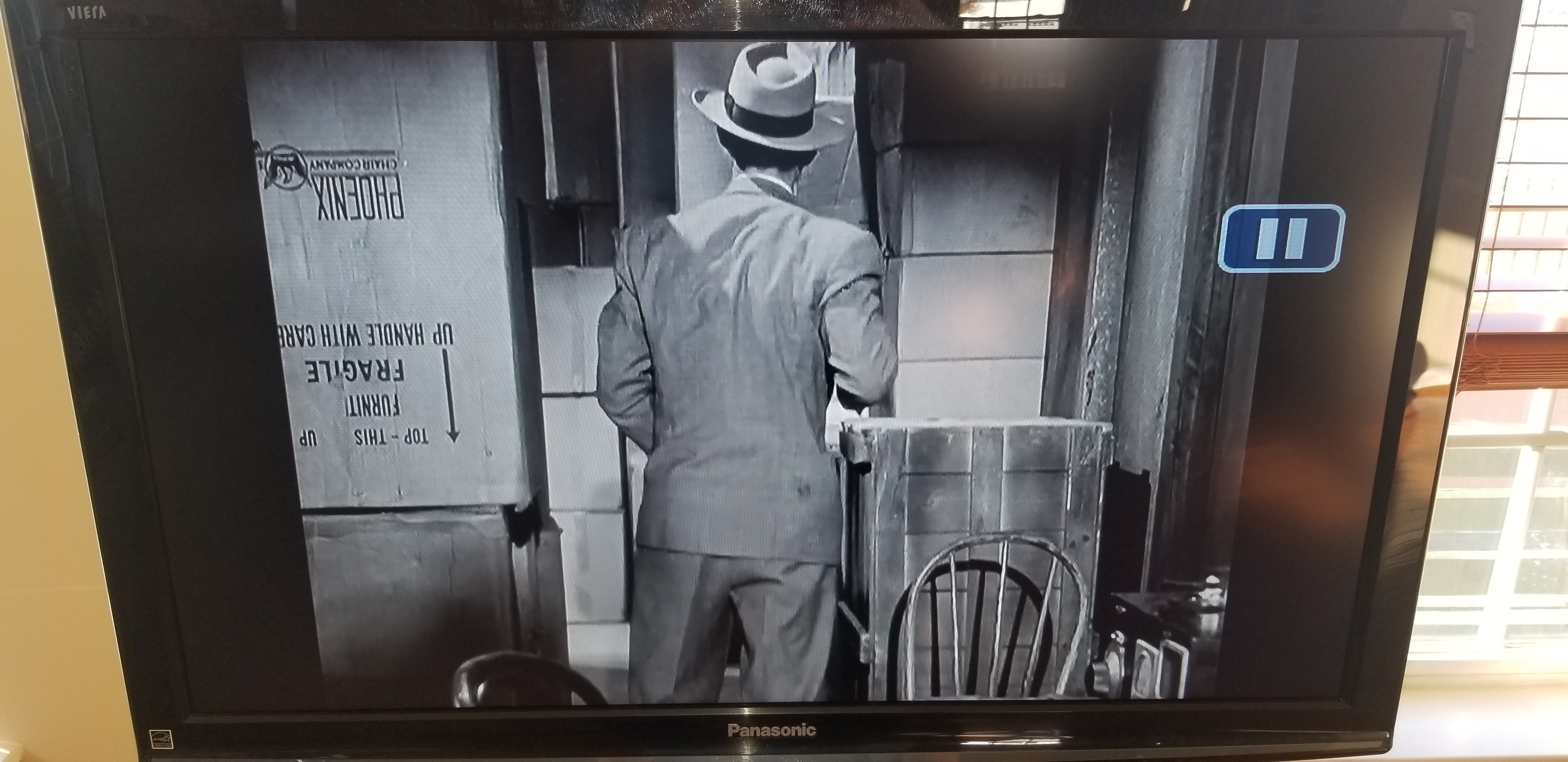
There are noticeable errors in the props. Consider the photo below. The prop department couldn’t take the extra 13 seconds to stack the boxes with This side up and the arrow actually pointing up? They also didn’t bother to construct a closet in the Bat Cave. In Episode 10, Batman and Robin are seen retrieving their outfits from the second drawer of a file cabinet. Those capes must be permanent press because they’re never wrinkled.

Most of all, there are noticeable errors in reality. Robin drives a convertible alongside a speeding train in order for Batman to jump aboard. The top is up, however, so, defying physics and the owner’s manual, Robin lowers the top while the convertible is at top speed. Everywhere but in Gotham City, this would convert your ragtop into a notop.

Speaking of Batman’s car, the Batmobile had not been conceived in 1949 so the Caped Crusaders cruise around in Bruce Wayne’s car, a 1949 Mercury. The female lead, photographer Vicki Vale, asks Batman, “Does Bruce Wayne know you’re driving his car?” Not very observant, that Vicki. Or anyone else for that matter.

I can’t slip out of my coat when the car warms up, but the Dynamic Duo manage to change clothes in that Mercury. How do they do that? But then, how can Bruce Wayne and Dick Grayson see the Bat signal flashed against the sky in broad daylight? When they do, they enter the Bat Cave through a grandfather clock in Bruce’s study. A grandfather clock?

Batman and Robin are constantly overestimating their abilities. Batman will jump on three villains at once, ignoring the odds—and reality—and, of course, he ends up unconscious in a soon to be blown up house or some such predicament. That man has sustained more concussions than a Whack-a-Mole, which may explain why he doesn’t just whip out a pistol or a stun gun or mace or a telescopic baseball bat and save himself a beating. But then, I guess you have no room for that stuff when you are carrying a full-sized acetylene torch, which Batman pulls frm his utility belt and cuts his way through a steel door.

Naturally, the hoodlums all working for “The Wizard” never stick around to make sure that the poison gas actually kills Batman behind that steel door because these knuckleheads are dumber than the plot. You’d think after the third or fourth resurrection, someone would rummage around in the remnants of the blown up cabin or burning outhouse or whatever, to look for a cape or a bat ear or something. I blame The Wizard for hiring second rate henchmen. He may have invented a “remote control machine,” but he doesn’t appear to be much when it comes to judging criminal talent. I guess good help was hard to find back then, too.

The production of this serial is so slipshod that in Episode 8, “Robin Meets the Wizard,” Batman says to his sidekick as they’re driving along with a Geiger counter tracking radioactive money (don’t ask), “Sounds like it’s getting louder.” To which Robin replies, “I guess we’re getting louder.” This makes no sense until you realize that actor Johnny Duncan meant to say, “I guess we’re getting closer.” I’m thinking that the sound editor had already given up by this point.

Not me. I’m not giving up. I can’t wait for the next idiotic . . . I mean thrilling chapter of New Adventures of Batman and Robin, the Boy Wonder.

Postscript

You can catch all the action on YouTube by clicking here.

Actor Robert Lowery, who plays Batman, sounds quite a bit like Adam West. Or vice-versa.

My favorite side note is that Johnny Duncan, the actor who portrays Robin, was such a good swing dancer, that he landed a part in a Benny Goodman movie, The Gang’s All Here, which was the beginning of his acting career. He appears, often uncredited, in a variety of swing movies including Kay Keyser’s Swing Fever, but also shows up in other films throughout the ‘40s and ‘50s and up to 1960 when he had a bit part in Spartacus. This goes to prove that it pays to learn to dance.

Posted in Life is Interesting, Uncategorized | Tagged , , , , , , , | Leave a comment

The curious case of two first basemen

Consider the case of the following two first basemen.

Player A played 18 seasons and was an eight-time All-Star. He received MVP votes in nine different seasons with a top finish of 7th. His Career Shares MVP score as calculated by baseball-reference.com is .65, which ranks 402. He made seven post-season appearances and was part of two World Series winners.

He won three Gold Gloves, but never topped his league in any fielding category in any season. Twice he led the league in sacrifice flys, twice in games played, and once in strike outs.

For his career, he hit 370 home runs and tallied 1,274 RBI. His career slash line was .273/.359/.487.

Player B is Player A’s 7th most comparable hitter according to baseball-reference.com

Player B played 17 seasons and was a four-time All-Star. He received MVP votes in five different seasons, winning the award once and finishing 2nd and 3rd in two other seasons. His 1.95 MVP Career Shares ranks 107th. He made five post-season appearances and was part of three league championships and two World Series winners.

He never topped his league in any fielding category in any season. Once, he led the league in slugging percentage.

For his career, he hit 339 home runs and knocked in 1,187. His career slash line was .266/.361/.462.

Player A is Player B’s 9th most comparable hitter according to baseball-reference.com

Player A played the majority of his career in the late 1940s through the 1950s. Player B played the majority of his career in the 1960s through the mid-‘70s.

Is there that much difference between these two players that one should be in the Hall of Fame and the other should not?

Player A is Gil Hodges. Player B is Boog Powell.

The only discernible difference that I see between these two players is Hodges played on the Brooklyn Dodgers, the most romanticized team in baseball history, about which multiple books have been written, and many of those are coming-of-age baseball love stories. Boog Powell played 14 of his 17 seasons in Baltimore, where people named their kids after a certain third baseman.

Posted in Baseball in General, Hall of Fame | Tagged , , , , | 2 Comments

Autumn’s reality cannot compare to summer’s illusion

The reality of autumn cannot compare to the illusion of summer.

The tree leaves turn beautiful in autumn, but their dance to the ground reminds us that the earth’s vitality is about to pause. The afternoon air becomes comfortable, but the nights grow cold. The sunlight recedes, and individual days disappear quickly. The world becomes silent, save perhaps for the caw of some lonely crow flying over a brown landscape. Time marches on more decidedly in autumn. Winter may be the season of death, but death is followed by resurrection. Autumn is the season of dying.

Summer, on the other hand, stands still.

Yes, 24 hours pass by just as quickly at the end of June as at the end of November, but summer’s illusion obliterates that reality!

There is no time in summer; just one long day punctuated by short nights. Noon or midnight, shorts and a t-shirt will suffice. The days are alive with insects and birds, who will also remind you all through the night that the Season of Life is in full swing, as if to say, “Lie down and rest for a while, we’ll keep the party going!” A summer day doesn’t slam shut at 5 o’clock; it slowly recedes into the twilight. Summer nights are mere pauses, not grinding halts.

Perhaps, I misspoke earlier: Summer is not an illusion, it is a borrowing; a borrowing from the past. Not only do the flowers and the birds return, but so does our childhood. One long continuous day without reference to a series of holiday dates or the need to keep an eye on the latest forecast. As in our youth, we burst out of our doors, the screen slamming behind us; burst upon the rivers and picnic grounds and hiking trails; onto the ball diamonds and into the gardens. We burst upon the earth with no less enthusiasm and no less color than the flowers.

Heat and humidity and weeds and mosquitoes are but a token price to pay for a return trip to childhood. Summer is activation, not hibernation, and while living as long as I have has limited my personal possibilities, summer reminds me that the world in general still possesses endless possibilities.

Summer is the magic time.

Posted in Life is Interesting | 4 Comments

Dear MLB: Your problem is relevancy, not boredom (although, that’s easily fixed, too.)

Dear Major League Baseball,

Much has been written recently about your “boredom problem.” Longer games with less action have resulted in declining attendance and declining television ratings, but the solution to your on-field problem is so simple that a Little Leaguer could tell you what it is, whereas a board room full of consultants obviously cannot:

Deaden the ball.

Don’t change the rules, change the dynamics of the game’s most basic piece of equipment.

You want more defensive plays? Lessen the chance that the ball disappears over the fence. Maybe reduce those exit velocities so that batted balls don’t go screaming past fielders at 108 miles per hour. Perhaps then, teams will rediscover baseball’s most important offensive strategy: Don’t make an out. If a batter is guaranteed to not make an out by playing pepper with the 45 feet of open dirt over there by third base, for example, then play pepper with the dirt. You can’t make pitchers throw the ball with less velocity nor make batters hit the ball with less force, but you can change the ball so it doesn’t resemble the Road Runner when it is finally put in play.

Baseball suffers a much deeper problem, however, than long games with lots of strike outs. It is losing its cultural relevancy.

Commissioner Manfred, you and your merry band of marketing consultants try to sell baseball as spectacle, when it is not. Certainly, there are bursts of the spectacular that take place on the field in almost every game, but those bursts are always within the context of the game itself. Baseball is story. Every season is a story. Every game is a story. Story involves plot and one of baseball’s beauties is that fans never know when the climax of that story will occur. It might take place in the first inning, but we can’t be 100% certain until the story concludes. The climax may be a mad dash from first to home on a double in the gap in the bottom of the 9th, but it might have occurred in the fifth inning when one team loaded the bases with none out, but didn’t score. The best games feature rising action on almost every pitch, but even those 12-0 blowouts allow the fan to appreciate the construction of the game. Watching the third baseman set himself on every pitch, for example, is akin to reading a book whose plot is weak, but is well-written nevertheless.

You powers there at MLB understand none of this. Football is spectacle. In fact, it has become such a spectacle that it is marketed more as “sports entertainment” like World Wrestling Entertainment than as sport. If football was a story, it wouldn’t interrupt itself with endless replays and tedious timeouts. It wouldn’t try to stretch its one hour product into three and a half hours. Football can get away with this, because spectacle can be sustained once a week during the fall and winter. It is impossible to sustain it every night of the spring and summer.

Thankfully, baseball by its very nature will never be that and it should quit trying to be that if it wants to maintain any relevancy. The baseball poets, such as W. P. Kinsella, have composed lyrics about the pastoral nature of the game; that it permits conversation and fellowship; that it permits, indeed, insists, that we slow the pace of our lives, sit back and enjoy the green grass, the summer sunsets, the olfactory awesomeness of a grilled hot dog. This is what baseball provides far better than any other sport, and as Kinsella might say, it is what we need now more than ever. It is what you, Commissioner Manfred, should be selling.

Put another way, baseball has the capacity to make us mentally and spiritually healthier. Baseball marketers do not have to create this need in order to sell their product, this need already exists in us and the need is growing exponentially as the world grows more chaotic.

No, MLB, you don’t need more marketing consultants, you need to bring back your best sales people; you know, the ones you have been tossing aside the past couple of decades in your attempts to spectacularize the game. There are no better salesmen of baseball than dads and moms and grandpas and grandmas. It was my mom who was a huge baseball fan and it was her stories about the minor league Baltimore Orioles of her childhood that fascinated me. At 16, she was in love with Don Heffner—I still have the scrapbook in which she pasted his eventual wedding announcement. My parents took me to Game 3 of the 1966 World Series and, even though he wasn’t pitching, Mom made sure that I took a good look at Sandy Koufax so that I could say that I at least saw him in the flesh.

I was only nine years old in 1966, but baseball was an entry into adulthood. Perhaps, not authoritatively, but on this one topic at least, I could speak as an adult. Adults also spoke to me, and almost every city had that one avuncular voice that would come through the radio, welcoming me to Memorial Stadium or Tiger Stadium or Wrigley Field. Here was an adult—in my case, Chuck Thompson in Baltimore—talking to me, telling me the story of the game. Neither he, nor any of the other marvelous voices of major league baseball, bored me with statistics that I’d need a calculator and a master’s degree to interpret. They were human beings having a human conversation, and not verbal translators of the Statcast machines. Someone once looked at Phil Rizzuto’s scorecard and became puzzled by the notation, “w.w.” When asked, Phil replied that it stood for “wasn’t watching.” Today’s radio broadcast booth is often packed with so many analogous voices all spouting statistics in their, I’m an insider smarminess, that I can’t tell one from another. Give me the guy who wasn’t watching and who tells me a story (maybe fictional, but who cares?) about that guy from Jersey City who just caught a foul ball behind the Yankees’ dugout. Mr. Manfred, one story-telling uncle, whether in the booth or sitting beside you, will sell your product better than a dugout full of statisticians.

The biggest problem for baseball the game is Major League Baseball the corporation. The latter does not understand the former’s most important selling points and that is why the game is losing its relevancy.

I hope this note reaches the right board room or luxury suite, and I hope it stings. I hope it hurts. I hope some baseball executive somewhere sits up and takes notice of someone who is writing on behalf of a bunch of someones, all of whom really care about our game. Frankly, Major League Baseball, you’re a mess, but in the end, this is a love letter.

~~Austin Gisriel is the author of Fathers, Sons, & Holy Ghosts: Baseball as a Spiritual Experience.

Posted in Baseball in General | Tagged , , , , , , , , | 8 Comments

Building lairs and hideouts for master criminals

While watching an episode of the 1943 serial, The Batman (the first time the Caped Crusader was ever presented on celluloid, by the way), I was intrigued by the evil Dr. Daka’s elaborate underground headquarters. That got me to wondering about the construction firms that build dens for demonic denizens and villain villas and the like. Somebody’s got to do it, right? I mean, you can’t just look up Acme Construction in the phone book and ask for a nice split-level lair complete with a secret room behind a revolving bookcase. Well, I guess you could, but I’d want to hire an outfit that had experience and expertise in such construction.

How would such a company make itself known to its potential customer base? You can’t just rely on word-of-mouth until your reputation is firmly established, and even then such a business is subject to the same rules of marketing as any other business, which means that it is imperative to keep its name in front of the public.

After doing some research in the Ne’er Do Well Architectural Digest, the leading periodical for the criminal hauteur, I came across the following ad:

Looking to build yourself a nifty hideout or renovate and old one?

LAIRS FOR LESS CONSTRUCTION COMPANY

Is in the business of building you a bright, modern headquarters, complete with all the amenities anyone wanting to take over the world would want. This week we’re running a trap door special: Install three trap doors or more and we’ll include your choice of spiked floor, moving walls, or an alligator pool! (Alligators not included.) Whether you want to rid yourself of pesky policemen or nosey super heroes, or you just can’t stand your mother-in-law, a trap door is a traditional, yet elegant manner of disposal.

NO JOB IS TOO SMALL!

Whether you want to install a retractable roof that will allow your laser to bring down satellites or you want to install an attractive and modern kitchenette in your laboratory, LAIRS FOR LESS CONSTRUCTION COMPANY is the company you should choose.

“Our bizness is stayin’ out of your bizness.”

Free estimates.

Licensed and bonded.

That reminds me: Doesn’t the phone company know that Bruce Wayne is Batman since they installed the Batphone?

Posted in Uncategorized | Tagged , , , , | 2 Comments

The war ends for Fibber McGee and Molly

In March of this year, I wrote about the Fibber McGee and Molly episode that was broadcast on December 9, 1941—when fires still burned at Pearl Harbor. It’s taken six months, but I have listened to every episode from that broadcast through the broadcast of October 2, 1945, which was exactly one month after the Japanese signed the formal surrender on the deck of the U.S.S. Missouri. There is no better way to appreciate life on the home front than to listen to these broadcasts which are available at archive.org.

During the intermittent time, fifteen different episodes focused specifically on war-time conditions. Episodes from 1942, for example, are entitled, “Scrap Drive,” “Sugar Substitute,” “Spy,” and “Gasoline Rationing.” Episodes from the spring of 1943 include topics such as finding skilled workers, collecting for the Red Cross, and the perils of black market meat. When Fibber McGee and Molly returned from their summer hiatus that fall, one of the first shows was entitled “Renting the Spare Room,” in which a new character, Alice Darling, was introduced. Alice was a young, single woman who worked at the local airplane factory turning out warbirds for American forces.

The show was broadcast on Tuesday nights, which meant that it was broadcast on Tuesday, June 6, 1944. That night opened with a statement that began, “A three-dimensional war machine has swept out of the continent of Europe. With NBC, invasion news takes precedence over all scheduled programs.” Then Jim and Marion Jordan, the titular stars of the show, announced that they were awaiting bulletins just as was everyone else; they then turn the show over to the Billy Mills Orchestra, the show’s regular orchestra and nothing but music can be heard for the next half hour.

Ad for Fibber McGee and Molly

May 8, 1945 was also a Tuesday, a date to which we now refer as “VE Day.” That night’s show opened with regular announcer, Harlow Wilcox stating,

The curtain has fallen on the first act of the greatest drama the world has ever seen. The second and we hope the last world war. Act Two is going on in the Pacific Theater. In expressing our tremendous admiration and gratitude to our fighting forces, we feel that the best support of their efforts until complete and final victory, is by carrying on with our own jobs as best we can. In this case our job is to bring a few smiles to the home front and do our small bit toward easing the tension and anxiety in the homes of the men who are not here to laugh with us. So tonight, we present the regular Johnson’s Wax Program, as our stars go on the air in a spirit of tribute to the stars in your windows.

A more eloquent paragraph on any topic I have not read—credit to Don Quinn the show’s writer. The last line is perfect.

VE Day was not the end of the war, of course, a fact strongly reinforced two weeks later in an episode entitled, “Seventh War Bond Drive.” Americans were tired, very tired of the sacrifice and casualties, and they were rightfully fearful of the coming year and the cost of invading Japan. As the show’s summer hiatus drew near, no one then knew that the war would be over before the cast would reassemble in the fall.

But end, it did, and the first episode of the new season was “Welcoming LaTrivia Home From the War.” LaTrivia had been the mayor of Wistful Vista, the show’s fictitious setting, before joining the Coast Guard and an episode celebrating his return was symbolic of returning servicemen all over the country. Don Quinn didn’t have to use his imagination for this plot line: Gale Gordon, who played the part of LaTrivia left the show to join the Coast Guard and was now returned.

Alice Darling still lived with the McGees, but we find out in the October 2nd episode that she has been laid off from the aircraft plant, which is being converted into a baby carriage factory. Everyone was eager to convert to a life free from the war, but as the nation grew and radio converted to television and the baby boom boomed, the war continued to echo in the hearts of those who lived it. No one—not even the creator of Flash Gordon—could have dreamed then that one day, one of those baby boomers would tune in, not on a crackling Philco, but on something called a “smart phone,” which in this case, has become a time machine. The spirit of the home front during World War II, as well as a lot of laughs are out there. Just listen. It is a tonic to today’s troubled times.

Posted in World War II | Tagged , , , , , , , , | 4 Comments